

The High-Stakes Hook: Survival Mode is a Dangerous Game
In the grind of a mid-season schedule, many coaches fall into "Survival Mode." To protect players, the first thing sacrificed is often high-intensity power work. However, this defensive strategy carries a hidden cost. When athletes stop producing high-level neural output for as little as 14 days, they begin to lose Tendon Stiffness—the biological "spring" that allows them to store and release energy. Without this stiffness, players don't just get slower; they become more susceptible to connective tissue injuries. In-season speed training isn't about "getting faster"—it is about Mitigating Decay.
In practice, this decay rarely shows up as slower sprint times first. It shows up as softer ground contact, longer braking steps, and hesitation before the second action.
The Logic of Micro-dosing: Contextual Intensity
If you can’t afford a 60-minute lift, you must pivot to Micro-dosing. Micro-dosing is not about random movement; it’s about high-fidelity stimulus in a basketball context. For a mid-season session, we define the Minimum Effective Dose (MED) as a total resisted volume of 30–50 meters.
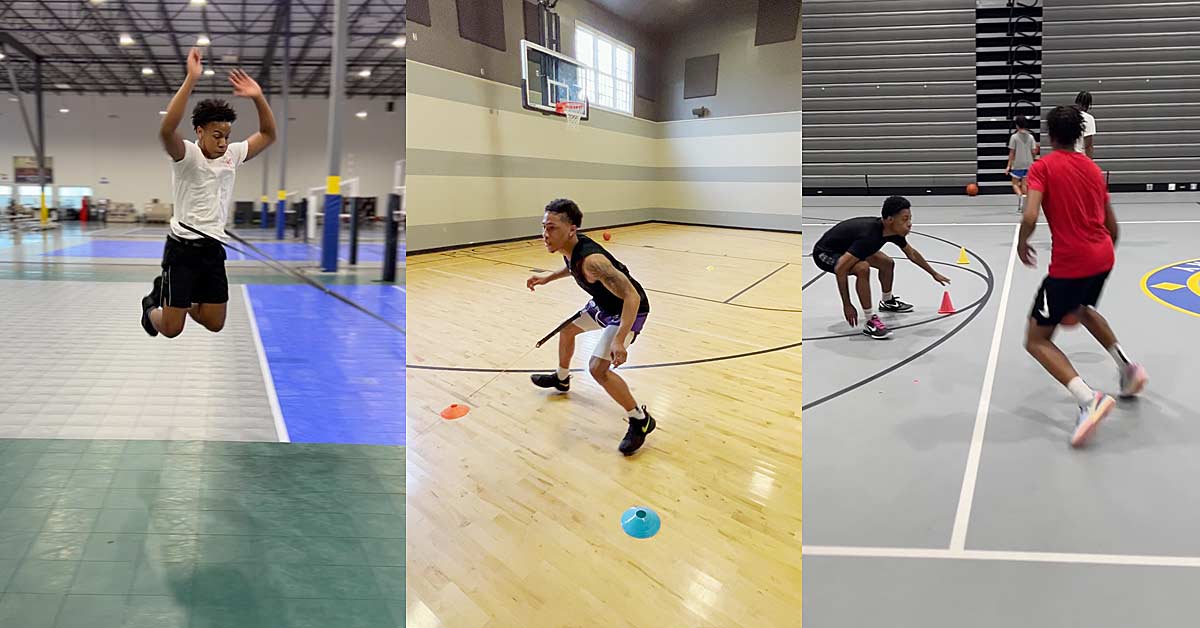
Think of this volume in game-specific terms: three full-court transition sprints or six 5-meter explosive "close-outs" from the paint to the perimeter. This approach achieves Neural Priming—waking up High-Threshold Motor Units—without crossing the threshold into metabolic fatigue. For the athlete, this feels like a "premium warm-up" rather than a grueling session, significantly lowering the psychological barrier to training on game days.
If athletes feel sharper after the first two reps but output drops on the third, the dose was already sufficient.
Beyond the Sprint: The Deceleration Penalty
Basketball speed is rarely linear; it’s a game of violent "starts" and even more violent "stops." As the season progresses, athletes often face a Deceleration Penalty—a loss of eccentric control that leads to non-contact ACL and patellar tendon issues. Maintaining Rate of Force Development (RFD) and braking stability requires a resistance profile that is stable and predictable. Most traditional tools fail here because they lack biomechanical honesty, often pulling a player out of their natural defensive stance.

What matters here is not the absolute peak, but the consistency of force production during the drive phase and the absence of disruptive load during the return.
Solving the "Resistance Paradox" with QDD Technology
Every coach has seen a player’s biomechanics crumble when a traditional elastic band "snaps back" at the end of a rep, forcing an unnatural weight shift. This is the Paradox of In-season Training: you need the resistance to build power, but you can't afford the erratic feedback or the muscle-damaging eccentric pull that leads to DOMS (Delayed Onset Muscle Soreness).
To solve this, t-apex utilizes QDD (Quasi-Direct Drive) technology. Instead of mechanical gears or rubber, QDD uses digital motor control to provide Constant Digital Tension. This allows for a Concentric-Only Mode: the device "feels" the athlete's explosive drive and provides elite-level resistance, but instantly vanishes during the return phase. You gain the neural recruitment of a heavy sprint with 0% of the muscle-damaging load, keeping the player’s movement pattern as "clean" and soreness-free as it is in a game.
The "5-Minute Gameday Pop" Protocol
You don't need the weight room. You need the baseline and five minutes.
- Explosive Re-activation (2 Reps x 5m): Medium resistance start using t-apex. Focus on maximum displacement in the first two steps of a transition break.
- Reactive Decel (2 Reps x 3m): High-velocity start, followed by an immediate "stick" landing the moment resistance is released. Focus on core and knee stability during a hard stop.
- Lateral Stiffness (2 Sets x 5s): Rapid resisted lateral shuffles to maintain neural feedback for defensive slides and "staying in front."
From Training to the "Readiness Dashboard"
Ultimately, speed training with t-apex transforms from a physical burden into a Monitoring Dashboard. By tracking Peak Power Output during these micro-sessions, you gain an objective lens into your roster’s recovery. If a player’s power output drops 10% below their baseline, you don't need to guess if they are fatigued—the data has already told you. Speed work is no longer just a drill; it is the ultimate "early warning system" for your team’s health and performance.
In-season performance is no longer about how much work you can tolerate. It is about how precisely you can preserve output, control fatigue, and make the right adjustment before quality disappears.
Book a demo and see how decision-driven speed training works in practice.