
Intro — Keeping Rhythm Alive in the Middle of the Season
A competitive season is a marathon disguised as a series of sprints.
Games, travel, short turnarounds, and accumulated fatigue make it nearly impossible to maintain full training loads without risking performance drop-off or injury.
This creates the core dilemma every team faces in-season:
How do you stay sharp without breaking down?
How do you recover without losing rhythm?
Sustain Neurological Sharpness Without Fatigue
Most in-season programs struggle with load balance.
Micro-sessions provide the middle ground — short, targeted blocks that maintain tempo, eccentric control, and movement rhythm without adding unnecessary fatigue.
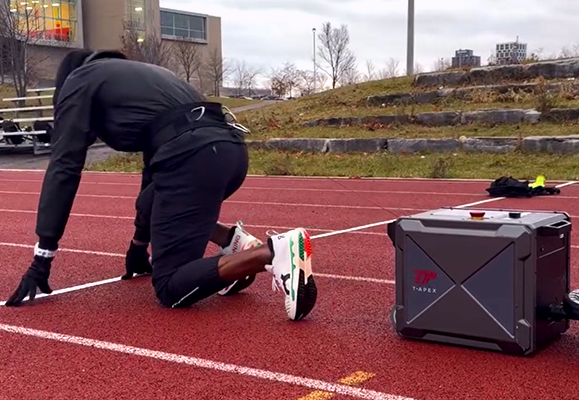
T-APEX fits naturally into this model.
Its adjustable resistance supports technique under low load, while tempo and eccentric modes reinforce rhythm without stressing the system.
Real-time data ensures each rep stays within the “effective but safe” range.
This keeps movement timing “online,” even during congested schedules.
The result: Rhythm stays intact. Power stays accessible. Athletes stay ready.
Below is an example of how a full micro-session can be structured:
| Phase | Duration | Purpose | T-APEX Setup |
|---|---|---|---|
| Dynamic Warm-Up | 5 min | Activate neuromuscular system & prep stride rhythm | Assistance mode / very light load (0.5–1 kgf) |
| Tempo Drills | 5 min | Reinforce movement timing & aerobic sharpness | Isotonic 1–2 kgf; 10–15 m rhythm strides |
| Eccentric Control | 5 min | Improve braking force absorption & joint stability | Isotonic light load; delayed braking mode |
| Light-Load Sprint Activation | 5 min | Elevate stride frequency & neural speed | Assistance / low load (1–2 kgf) |
Adjustments for Different Performances
Not every athlete requires the same in-season emphasis.
Rather than dividing work strictly by position, a more effective approach is to classify micro-sessions by performance qualities — the underlying abilities that drive on-field actions across many roles.
T-APEX allows coaches to fine-tune these qualities with precise load, tempo, and movement control.

Acceleration Work
For athletes who rely on breakaway speed.
→ Light-load tempo strides + assistance mode; monitor early-phase efficiency.
Change of Direction & Braking
For athletes who defend, react, or cut under pressure.
→ Eccentric control work + delayed braking; track RMS for rhythm consistency.
Short-Range Power
For athletes in close-contact or low-velocity battles.
→ High-resistance controlled drives; monitor Peak Power output.
Metrics for Consistency — What Coaches Should Monitor
The goal of micro-sessions is not to push max output.
It’s to make sure the athlete’s “movement signature” stays stable week after week.
T-APEX provides four key markers that reveal readiness:
| Metric | What It Shows | How Coaches Use It |
|---|---|---|
| RMS (Average Power) | Rhythm stability & propulsion control | Drop in RMS = rhythm breaking → lower load / shorten session |
| Time to Peak | Neural sharpness & acceleration efficiency | If Time-to-Peak lengthens > 10%, indicates CNS fatigue |
| Distance to Peak | Spatial efficiency of early-phase acceleration | Increasing distance = taking too long to build speed |
| Peak Velocity | Output ceiling under controlled load | Drop in peak speed = fatigue or technique inconsistency |
Rhythm Stays On. Performance Stays Up.
In-season success isn’t built on high volume — it’s built on keeping rhythm, control, and neuromuscular sharpness alive even when training time is limited.
T-APEX makes this process simple:
- Micro-sessions you can run anywhere
- Adaptive resistance that matches the athlete’s needs
- Data that ensures every rep stays within the “optimal load window”
- Tempo & eccentric work that maintains performance without adding fatigue
Short sessions. Smart load. No performance drop-off.